


In the paper industry, production equipment sometimes needs to be adapted to process products that it was not originally designed to handle. These new operating demands can put additional stress on certain mechanical parts, causing repeated breakdowns and production delays.
Is it more efficient to replace a machine that is still operational, or to upgrade components that are no longer fit-for-purpose?
A leading company in the paper industry opted for the second approach, commissioning Thomas Constructions Mécaniques (TCM) to retrofit and improve the reliability of an industrial roll splitter used to cut non-compliant cardboard rolls.
The goal was to reinforce mechanical components subject to high stress, make the roll handling process more reliable and extend the equipment’s service life, without changing its current operating principle.
An industrial roll splitter subject to new production demands
The roll splitter at this paper mill plays an essential role in recovering non-compliant products. It cuts up cardboard rolls, facilitating their transfer to a pulper. They are then reintegrated into the manufacturing process.
Its operation consists of several stages: the roll is loaded onto the tilting cradle which is lifted by two hydraulic cylinders. The first conveyor system then moves the roll into position beneath the roll splitter. After the roll has been cut into smaller pieces, the second conveyor then transfers the cardboard to the pulper.
However, due to increased roll dimensions, the limitations of certain mechanical components gradually became apparent.
The rolls handled are now larger, reaching up to 2,600 mm in width, 1,500 mm in diameter and 3 tonnes in weight. These increased loads were causing two recurring problems: deformation of the tilting cradle and failure of the feed conveyor’s slat fixings.
A long-term solution was required to prevent these failures, rather than continuing with temporary repairs.
The challenge: eliminating the root cause of these failures without replacing the roll splitter
PROJECT CHALLENGES
- Reinforcing the tilting cradle to withstand the loads exerted by the rolls
- Improving the reliability of the two hydraulic lifting cylinders
- Preventing breakage of the slat fixings on the first conveyor
- Facilitating future maintenance operations
- Completing the modifications during scheduled production shutdowns
A tilting cradle subjected to high mechanical loads
During certain handling operations, the roll often moved backwards, exerting significant force on the cradle, and resulting in repeated deformation of the original structure.
The two hydraulic cylinders were not identical, further compromising the system’s reliability.
Conveyor fixings weakened by mechanical stress
On the first conveyor, wider rolls would rest directly on the screw heads of the slat fixings, rather than on the sliding strips as intended.
This uneven load distribution caused the fixings welded onto the chains to break.
The retrofit therefore needed to increase the strength of these components, as well as improving their design and facilitating maintenance.
Our solution: a customised mechanical retrofit designed and manufactured by TCM
Rather than replacing the entire roll splitter, TCM developed a targeted solution to upgrade the mechanical components under the most mechanical stress.
After conducting an on-site technical inspection and taking measurements, our design office developed a new tilting cradle and identified the modifications required for its integration.
A new, reinforced tilting cradle for improved roll handling
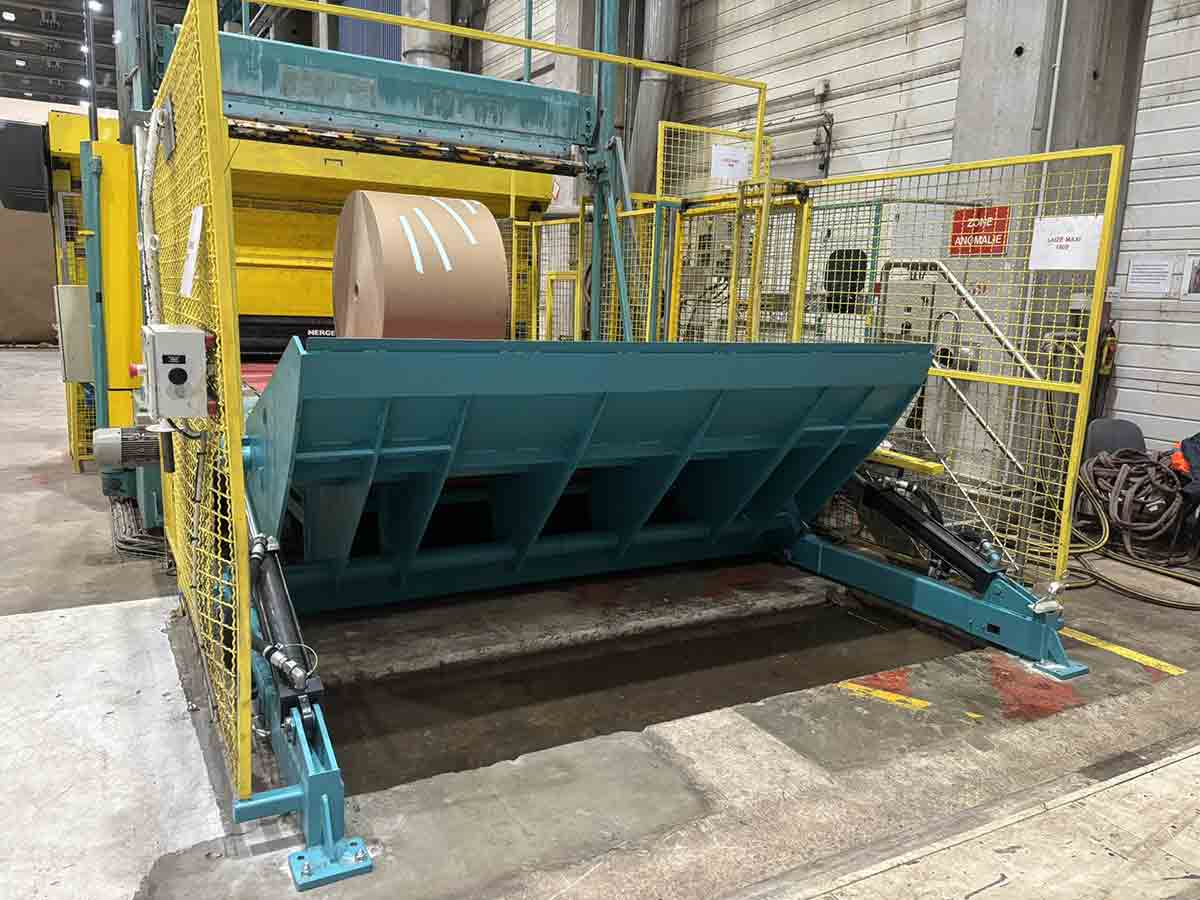
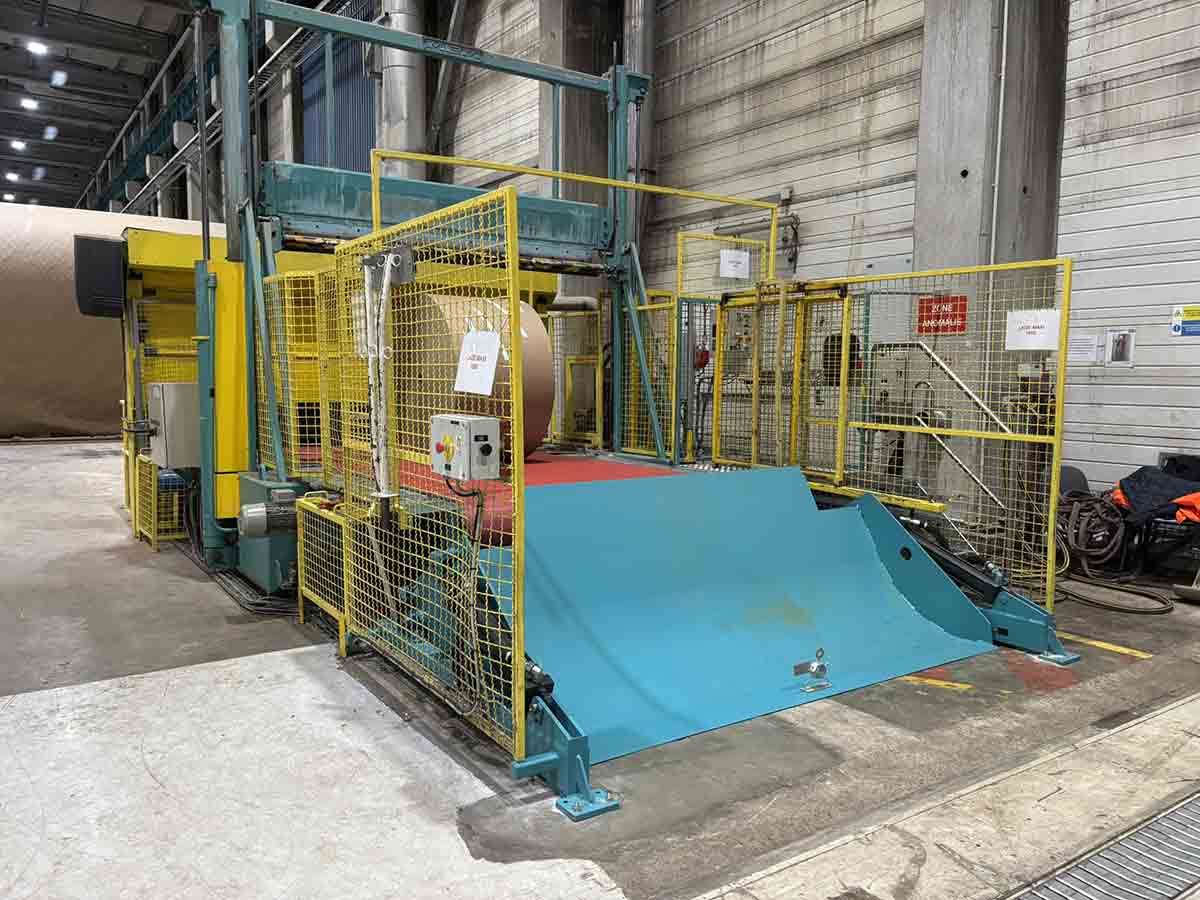
TCM designed and manufactured a new painted steel tilting cradle, with a reinforced structure to provide greater mechanical strength than the previous version.
The new model incorporates structural reinforcements that can be seen at the rear of the cradle, designed to withstand the loads exerted by heavy rolls.
TCM also upgraded the hydraulic lifting system, installing two cylinders with identical specifications, and modifying the pipework and hoses.
A reinforced conveyor system with accessible fixings for easier maintenance
The feed conveyor was also upgraded as part of the project.
TCM’s solution involved modifying the slat fixings using tapped bars and new Fillister head screws, as well as installing support beams made from UPE profiles fitted with plastic sliding strips.
These modifications aimed to provide increased support for wider rolls, reduce excessive loads on the fixings and facilitate maintenance of the conveyor slats.
Seamless integration into the existing facility
A major advantage of this approach is its efficient implementation.
The new tilting cradle was designed around the existing roll splitter, and workshop testing was carried out before installation. On-site work was scheduled around maintenance shutdowns to minimise disruption to the production process.
OUR SOLUTION
A customised mechanical retrofit, including the design and manufacture of a reinforced tilting cradle, increased reliability of the hydraulic system, upgraded conveyor fixings and improved sliding surfaces. This targeted solution was designed around the machine’s actual operating requirements.
The benefits of retrofitting an industrial roll splitter
The added value of this upgrade goes beyond replacing worn components. It addresses the root causes of recurring failures to improve equipment reliability over the long term.
BENEFITS FOR THE CUSTOMER
- Reinforced tilting cradle designed to withstand increased mechanical loads
- Redesigned conveyor fixings to reduce the risk of breakage
- More accessible fixings for easier maintenance
- Retention of the existing roll splitter and its original operating principle
- Reduced investment costs due to targeted upgrades
- Improved reliability to ensure production continuity
Why choose TCM for the retrofit of your production machinery?
Every industrial machine has its own specific requirements, from operating conditions and wear and tear, through to its maintenance history and production demands.
With our in-house design office and manufacturing workshop, TCM applies its extensive expertise to assess existing equipment, design customised mechanical upgrades, manufacture replacement components and install them on-site.
Based in the Vosges department, in the heart of the Grand Est region, TCM works with industrial companies, particularly in the paper industry, to upgrade their equipment, improve reliability and extend machine service life.
Are you experiencing repeated machine failures? Retrofitting could be the solution.
The entire machine may not need replacing, even when experiencing issues like deformation of a tilting cradle, failure of conveyor fixings or mechanical components that no longer meet production requirements.
TCM works with its customers to design, manufacture, and install industrial retrofitting solutions tailored to their specific needs.
Contact our design office today to discuss upgrading your industrial machinery.